And I will wait upon the LORD, that hideth his face from the house of Jacob, and I will look for him. Isaiah 8:17


If you are looking for messages about the Europe Area Humanitarian Mission, go to http://stayinginfrankfurt.blogspot.de/

If you are looking for Old Testament Videos, go to
http://salemzion.org/new/index.php/resources/adult-institute-old-testament/


Friday, January 10, 2020

ScripturePlus

ScripturePlus is now available for Android!!!

Book of Mormon Central is doing some great work: take advantage of the resources they are putting at your fingertips for FREE!

Look for ScripturePlus (all one word) at your Apple app store or, if you have Android, at Google Play.

FREE 

Sunday, January 5, 2020

CFM Week 1: Book of Mormon Introduction

I taught CFM Week 1: Intro to the Book of Mormon today.
I started by mentioning that the Title Page is scripture and we talked about some of the covenants mentioned in the BoM.  I then quoted 1 Nephi 2: 20-21

20 And inasmuch as ye shall keep my commandments, ye (Nephi) shall prosper, and shall be led to a land of promise; yea, even a land which I have prepared for you; yea, a land which is choice above all other lands.

21 And inasmuch as thy brethren shall rebel against thee, they (Laman and Lemuel) shall be cut off from the presence of the Lord.

I noted that this is sometimes summarized as : If you are righteous, you will prosper; if you are wicked, you will be cut off.

Which is a restatement of the covenant offered to Israel at Sinai : Leviticus 26.


Leviticus 26:1 . . . I am the Lord your God.
2 Ye shall keep my sabbaths, and reverence my sanctuary: I am the Lord.
3 If ye walk in my statutes, and keep my commandments, and do them;
4 Then I will give you rain in due season, and the land shall yield her increase, and the trees of the field shall yield their fruit. . . .
6 And I will give peace in the land, and ye shall lie down, and none shall make you afraid: and I will rid evil beasts out of the land, neither shall the sword go through your land.
7 And ye shall chase your enemies, and they shall fall before you by the sword.
9 For I will have respect unto you, and make you fruitful, and multiply you, and establish my covenant with you.
11 And I set my tabernacle among you:. . .
12 And I will walk among you, and will be your God, and ye shall be my people.
---------
14 But if ye will not hearken unto me, and will not do all these commandments;
15  . . . but that ye break my covenant:
16 I also will do this unto you; I will even appoint over you terror, consumption, and the burning ague, that shall consume the eyes, and cause sorrow of heart: and ye shall sow your seed in vain, for your enemies shall eat it.
17 And I will set my face against you, and ye shall be slain before your enemies: they that hate you shall reign over you; and ye shall flee when none pursueth you. . . .
21 And if ye walk contrary unto me, and will not hearken unto me; I will bring seven times more plagues upon you according to your sins.
22 I will also send wild beasts among you, which shall rob you of your children, and destroy your cattle, and make you few in number; and your high ways shall be desolate. . . .
25 And I will bring a sword upon you, that shall avenge the quarrel of my covenant: and when ye are gathered together within your cities, I will send the pestilence among you; and ye shall be delivered into the hand of the enemy.
26 And when I have broken the staff of your bread, . . . : and ye shall eat, and not be satisfied (famine).
30 And I will destroy your high places, and cut down your images, and cast your carcases upon the carcases of your idols, and my soul shall abhor you.
31 And I will make your cities waste, and bring your sanctuaries unto desolation, and I will not smell the savour of your sweet odours.
32 And I will bring the land into desolation:  . . .

Covenant Curse:  Famine, pestilence and the sword; carcases will lie on the ground; land made desolate; cut off from the presence of the LORD

Watch for this covenant throughout the Book of Mormon.

Next we discussed the various plates, using visual aids: here is my outline to talk about the various plates. (Good Luck!)


After losing the 116 pages, Joseph began translating where he had left off in Mormon's abridgement of the large plates of Lehi/Nephi.


Then the spirit told him to now translate the small plates of Nephi which contained more sacred writings covering the same time period as the lost 116 pages.


These plates begin with in the first year of the reign of King Zedekiah, so we went back and talked about the history of the northern kingdom of Israel, where Lehi and Ishmael's ancestors lived (tribes of Ephraim and Manasseh).  How the words of Isaiah prompted their grandparents to leave their lands in the north and travel as refugees to Jerusalem, which saved their lives.  Then Babylon attacks and occupies Judah and Jerusalem, removing and killing the king, taking 1000's into captivity and putting a puppet king, Zedekiah, on the throne.  So when the Book of Mormon opens in 1 Nephi, Judah is an occupied country, with Babylonian soldiers on the street corners.


Deuteronomy found in Temple in days of Josiah (when Lehi was a young man), who institutes reforms in religious belief and practice, replacing the older Israelite religion.


Lehi escapes Jerusalem then sends his sons back to get the brass plates.  I didn't have brass plates, only a brass bowl, so what was in there?


Genealogy back to Joseph of Egypt


Much of our current Old Testament up to the writings of Jeremiah, but also writings that never made it in to the bible of Judah.


I think that when the boys returned with the plates from Jerusalem, Lehi read the Psalms, beginning with Ps 1, 2 and 3.


Psalm Blessed is the man that walketh not in the counsel of the ungodly, nor standeth in the way of sinners, nor sitteth in the seat of the scornful.

But his delight is in the law of the Lord; and in his law doth he meditate day and night.
And he shall be like a tree planted by the rivers of water, that bringeth forth his fruit in his season; his leaf also shall not wither; and whatsoever he doeth shall prosper.
The ungodly are not so: but are like the chaff which the wind driveth away.
Therefore the ungodly shall not stand in the judgment, nor sinners in the congregation of the righteous.
For the Lord knoweth the way of the righteous: but the way of the ungodly shall perish.
Psalm 2: . . . Ask of me, and I shall give thee the heathen for thine inheritance, and the uttermost parts of the earth for thy possession.
Thou shalt break them with a rod of iron; thou shalt dash them in pieces like a potter's vessel.
Notice any ideas or themes that occur in Lehi's dreams?
Psalm 3 describes exactly what Lehi just experienced in Jerusalem: 
Psalm Lord, how are they increased that trouble me! many are they that rise up against me.
Many there be which say of my soul, There is no help for him in God. Selah.
But thou, O Lord, art a shield for me; my glory, and the lifter up of mine head.
I cried unto the Lord with my voice, and he heard me out of his holy hill. Selah.
I laid me down and slept; I awaked; for the Lord sustained me.
I will not be afraid of ten thousands of people, that have set themselves against me round about.
Arise, O Lord; save me, O my God: for thou hast smitten all mine enemies upon the cheek bone; thou hast broken the teeth of the ungodly.
Salvation belongeth unto the Lord: thy blessing is upon thy people. Selah.
The Hebrew word for Cheek Bone is LEHI.

Then there are the other 2/3 of the plates, which are sealed.
Wouldn't we love to read them?


CFM: I Nephi 1-7

Some very interesting archeological parallels with this part of the Book of Mormon are posted at

Saturday, January 4, 2020

Intro to the Book of Mormon : Videos available.


Hello!  A new year of Come Follow Me.  Here are about 3 hours worth of videos for the first week's lesson on the Title Page and Introduction to the Book of Mormon.  Enjoy

LDS.org (or whatever we call it now) Book of Mormon videos : These NEW videos were made to assist in your study of the Book of Mormon: they begin in 1 Nephi 1 and will continue thru the whole book.

Book of Mormon Central

The Title Page.  A video narrated by President Nelson https://www.facebook.com/bookofmormoncentral/videos/827589137668989/

The Story of the Book of Mormon: The Plates of Mormon  Title page: https://youtu.be/T_GErTonAFg
hat is the Book of Mormon? (the Introduction Narrated)  https://youtu.be/VfWx071CCXA

Joseph Smith’s personal history and testimony of the Book of Mormon : https://youtu.be/ofIvfB7DYKQ

Come Follow Me Lesson Videos
We have begun a new video series with BYU instructors Taylor Halverson and Tyler Griffin. In these two videos, they review the Title Page, Introduction, and the testimonies of the Three and Eight Witnesses.
Intro to the Testimonies of the Witnesses : https://youtu.be/YfBFhEkkXCo

Evidences of the Book of Mormon
Evidence for the existence of the Gold Plates : https://youtu.be/Mm-AXJNXiB8
                      See also this blog post :  https://bookofmormoncentral.org/blog/watch-new-video-on-evidence-for-book-of-mormon-plates    which gives all the footnote sources for the claims in the video so you can check them out yourself.

Evidence for the translation process of the Book of Mormon : https://youtu.be/4LdR7BoI6F0
              See also this blog post : https://bookofmormoncentral.org/blog/watch-book-of-mormon-translation-evidence   which gives all the footnote sources for the claims in the video so you can check them out yourself.
Book of Mormon Translation Timeline: a 1 ½ hour video of a John Welch presentation at Neal A Maxwell Institute   :  https://youtu.be/RT4bF3g4yHA

Sunday, November 10, 2019

Upcoming FREE Lectures by Terryl Givens. Come Enjoy him while he is in Utah!


Saturday  November 16  |  7 PM
Annual Neal A. Maxwell Lecture, featuring Terryl L. Givens
Hinkley Alumni Building, BYU
“Apologetics and Disciples of the Second Sort”


Monday November 18  |  4 PM
Lecture—Terryl L. Givens, “The Great Plan of Happiness”
Varsity Theater in the Wilk, BYU
Part 3 of a 4-part lecture series called "The Choice to Believe."
Details

Friday, November 8, 2019

Margot Butler's New Testament (Gospels) timeline


You know how much I love Margot Butler's Old Testament Timeline?

Well, she drew one for the New Testament as well!

Click on the image below to open a printable version of this handout.

Tuesday, November 5, 2019

Philemon and Onesimus: Look again.

Interesting post from Jana Riess on responses to the CFM curriculum treatment of the Epistle to Philemon: 


Mormons criticize LDS curriculum’s treatment of slavery in the New Testament


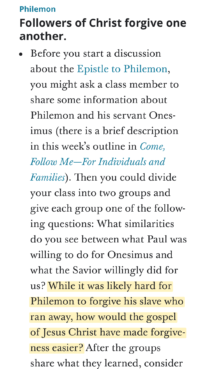
Screen shot of the LDS “Come, Follow Me” adult Sunday School curriculum.
(RNS) — On Sunday (Nov. 3), Mormon social media came alive with criticism of the curriculum for the Church of Jesus Christ of Latter-day Saints, which for the week’s lesson included a statement that suggested Paul was asking a fellow Christian, Philemon, to forgive his slave, Onesimus.
The adult Sunday School version of the lesson asks class members, “While it was likely hard for Philemon to forgive his slave who ran away, how would the gospel of Jesus Christ have made forgiveness easier?”
That prompted Zandra Vranes of Sistas in Zion to post on social media, “Why is the example for the master to forgive the slave for ‘running away?’ How does this example make it into church curriculum in 2019?”
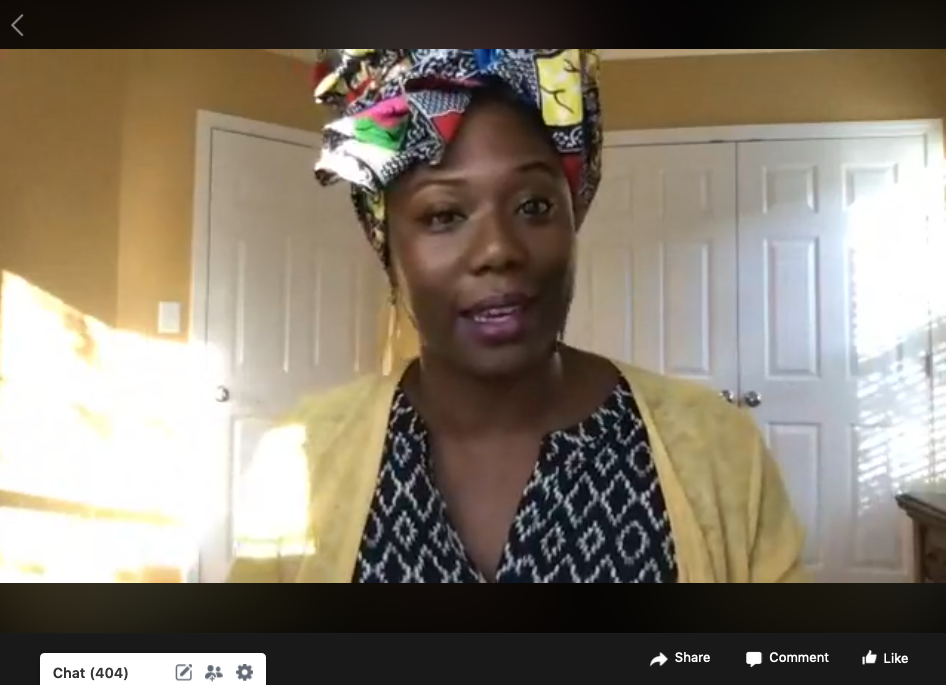
In the ensuing discussion, some tried to explain the context of Paul’s era, while others criticized Vranes for hypersensitivity. She later hosted a live Facebook discussion in which she replied to these critics, “You’re absolutely right. That’s true! Yes, I’m going to be more sensitive because I am black and I am a descendant of slave ancestry. That’s not bad. … We have to be able to take into account the ways that our lived experiences and the things that impact us . … are going to shape the way we receive discussions or we receive scripture or we receive teachings in the church.”
Vranes is right. She’s more keenly aware of the dynamics of privilege than most white Mormons ever have to be. I think it’s a safe bet that many white American Latter-day Saints looked at that line in the curriculum and said, “Yeah, how would having the gospel have made forgiveness easier for Philemon?” without also thinking to ask, “Why aren’t we more concerned about the horrible wrong that has been done to Onesimus by a slaveowner who is supposed to be a Christian?”
Zandra Vranes of Sistas in Zion discussing the Church’s curriculum on Philemon (Facebook screen shot).
One more time for the justice impaired: SLAVES DO NOT NEED TO APOLOGIZE TO THEIR MASTERS. If there is to be repentance and forgiveness, it ought to go the other way around. That should be a given. Slavery in the first-century Roman Empire may have been different from slavery in the 19th-century United States*, but every kind of slavery rests on the ownership of one human being by another, which is morally wrong.
In addition to the thoughtless white privilege, embedded in the church’s brief treatment of this story is an equally careless acceptance of unproven traditions about Paul’s letter to Philemon. The curriculum identifies Onesimus as someone who “escaped slavery” and as a “slave who ran away.”
Where in Paul’s actual letter does it say that Onesimus escaped slavery?
Answer: nowhere.
Some commenters have pointed out that the idea that Onesimus has run away ignores some key contextual clues from the letter itself. Nowhere in the letter does Paul say, “You’ll never guess who’s here with me in prison! Your slave, Onesimus!”
Presumably, that’s because Philemon already knows where Onesimus is — and Philemon knows because he’s the one who sent Onesimus to Paul in the first place. Roman prisons in this time period did not provide much in the way of food, blankets and support to prisoners, who therefore depended on friends and family on the outside. Philemon, a recent convert who owes Paul a debt of gratitude, may have sent Onesimus to provide Paul with the provisions he needed.
If this theory is correct, then the only surprise for Philemon in receiving Paul’s letter was not that Onesimus had connected with Paul, but that Onesimus had become a Christian. In Paul’s mind at least, the slave had been elevated to the status of a brother.
That may not have been in Philemon’s game plan. It suddenly raised all sorts of questions — not just about Onesimus’ personal fate or freedom, but the role that slavery would play in the new Christian movement going forward.
The fact that the LDS curriculum has skipped right over this (I understand the dilemma; it can’t cover everything) means that we may be missing an underlying point of Paul’s letter. Buried in all this talk of forgiveness is a rallying cry for a slave’s freedom.
Many of us modern readers would love for Paul to have made a declarative statement to Philemon that he could no longer own any slaves because he had become a Christian and slavery was wrong. Paul does not do this. Instead he focuses on the individual, the personal, and he makes his case through a series of Greek word plays that are lost on us today. The name Onesimus is a double pun of sorts in the letter.
First, the word Onesimus means “useful,” and Paul says Onesimus was formerly useless but he’s now living up to his name because he’s a Christian. Second, another word for “useless” (achrestos) is one letter off in Greek from the word for “non-Christian” (achristos), so Paul is going nuts with the fun puns here.
But he’s just getting started, because the more serious wordplay is what he does with “refresh/release” and “my guts/innards/heart.” Onesimus, Paul says, has become the companion of his heart and guts during this prison experience. (The KJV translates the term in verse 12 as “bowels,” but for reasons that are about to become clear, using that term in conjunction with “release” would offer too much glee to 11-year-old boys everywhere, who would delight at the image of Paul’s bowels being released. So let’s go with the more standard translation of “heart.”)
Paul wants his heart to be “released.” He has called Onesimus his heart. He’s sending Onesimus back to Philemon with this instruction — not an instruction for Philemon to forgive Onesimus for something it’s not even clear from the text that Onesimus actually did, but an instruction for Philemon to release Onesimus because the latter is now a brother in the gospel. Paul wants to have the “benefit” (onaimen, another pun on Onesimus’ name) of Onesimus for the cause of the faith.
Then Paul closes the letter with a sort of gentle warning that when he is out of prison he’s coming to Philemon’s house for a cozy little visit and a chat, so get that guest room ready (v. 22). Paul will be following through to check up on his instructions.
There’s no historical record of what Philemon did about Onesimus and whether he got Paul’s hints — subtle to us, but not to Greek readers in the first century — that Philemon needed to give Onesimus his freedom. But if we’re going to go with church tradition, which is apparently what the LDS Church is relying upon in interpreting this story, here’s a tradition I particularly like: Nearly half a century after this letter was written, the bishop of the church in Ephesus was an old man by the name of  … Onesimus.